Leading today, like time is limited

Most leaders act like they have unlimited time. Unlimited quarters. Unlimited chances to repair trust after a sloppy decision.
I don’t think that’s true, and not just in the obvious sense. Your credibility has a lifespan. Your team’s patience has a lifespan. Your culture has a lifespan. Memento mori leadership is my way of keeping that front and center, without turning work into something grim.
In Stoicism, the point of remembering time is limited isn’t to scare us. It’s to wake us up. It pushes me to choose people over politics, and long-term impact over short-term optics, while there’s still time to make it count.
Memento mori as a Stoic leadership practice

“Memento mori” is a simple Latin reminder: remember you will die. The Stoic move is what comes next: So what will you do with today? If you want a deeper overview of Stoicism beyond pop quotes, the Stanford Encyclopedia of Philosophy entry on Stoicism is a solid grounding.
Here’s how I translate it into daily Leadership:
- I treat attention like a budget, I spend it where it matters.
- I don’t confuse loud opinions with moral authority.
- I don’t worship outcomes, I focus on choices I can stand behind later.
If you want a practical history of how memento mori has shown up from ancient life to modern practice, this piece on Modern Stoicism adds helpful context.
The real cost of politics and optics
Office politics is rarely “evil.” It’s usually fear with good grooming.
I see it when leaders delay hard calls to avoid blame, over-explain to sound safe, or hoard info so they can control the story. The short-term result can look clean. The long-term result is a team that stops taking risks and starts performing for the room.
A realistic scenario: a senior leader hears a rumor about a re-org. They say nothing, to “avoid distraction,” while quietly lining up allies. Two weeks later the team learns the truth through back channels. Even if the plan is smart, trust takes a hit that no slide deck fixes.
Memento mori cuts through this because it asks: If my time to lead here is limited, what kind of leader do I want to be remembered as? Not in a dramatic way, in a practical way. The answer changes what I say in the next meeting.
The Memento Mori Decision Filter

When I’m rushed, I reach for a filter. Not a model. Not a memo. A few sharp questions that force honesty.
Here’s my Memento Mori Decision Filter (print it, save it, keep it close):
- If I had 6 months left in this role, would I still choose this?
- Who pays the hidden cost of this decision (burnout, stress, lost growth)?
- What would I advise my best employee to do if they were in my seat?
- Does this build trust, or just buy silence?
- Am I optimizing for this quarter’s story, or the next 3 years of health?
- What problem am I avoiding by choosing the “easy” option?
- If this goes wrong, can I defend the process with a straight face?
That last line matters. Process is what you own. Outcomes have weather.
A meeting agenda that reduces politics
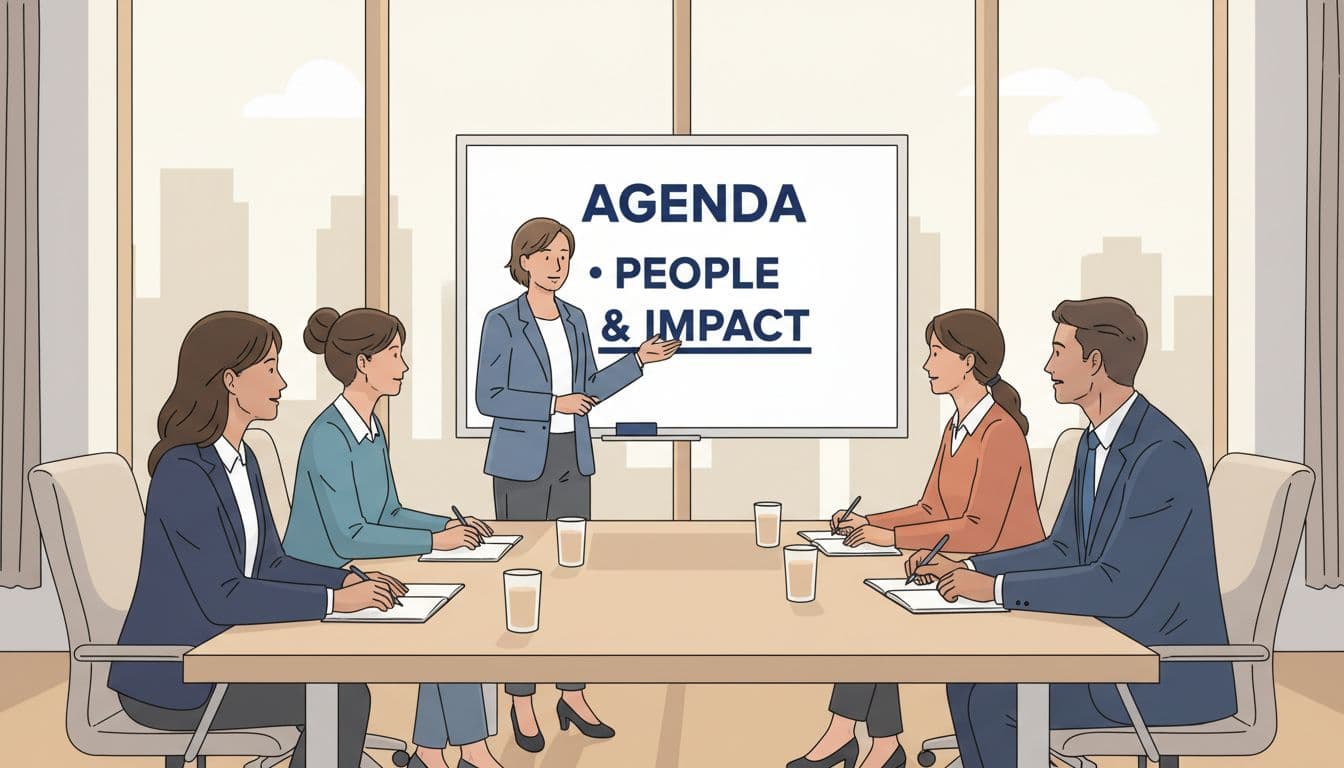
Politics thrives in vague meetings. So I run a tighter agenda, one that makes it harder to posture and easier to contribute.
People-over-politics agenda template (45 minutes)
- 00:00 to 05:00, Outcome and constraints: “We’re here to decide X, by end of meeting.”
- 05:00 to 12:00, Reality check: What do we know, what don’t we know, what changed?
- 12:00 to 25:00, Human impact first: Who will this help, strain, confuse, or block?
- 25:00 to 35:00, Options and trade-offs: Two to three options max, name the cost of each.
- 35:00 to 42:00, Decision or next step: Decide, or assign a short path to decide.
- 42:00 to 45:00, Commitments out loud: Who does what, by when, and how we’ll tell people.
If you want a leadership ethics angle that matches this “serve people, not ego” stance, this overview on ethical and servant Leadership is a useful read without getting dense.
A short pre-mortem for long-term impact
Stoic leaders plan without pretending they can control everything. One practice I use is a quick pre-mortem, which keeps me honest about second-order effects.
The 10-minute pre-mortem
- Name the decision in one sentence.
- Jump ahead 12 months. Assume it failed.
- Ask: “What caused the failure?” List 5 reasons fast.
- Circle the top 2 causes you can influence this week.
- Add one safeguard per cause (a check-in, a policy, a message plan, a metric).
Example: You roll out a “return to office” rule. It fails because managers apply it unevenly, and top performers feel punished. Your safeguards might be a manager playbook, a clear exception path, and a 30-day review based on retention and engagement, not vibes.
This isn’t pessimism. It’s stewardship.
“Say this / Not that”
Small shifts in language can move a team from suspicion to stability.
| Situation | Say this | Not that |
|---|---|---|
| You don’t have the full answer | “Here’s what I know today, and what I’m confirming by Friday.” | “Don’t worry about it.” |
| A tough call hits morale | “This is hard, and I get what it costs. Let’s talk through impact.” | “It is what it is.” |
| You need honest feedback | “Tell me what breaks if we do this, you won’t be punished for it.” | “Any concerns?” |
| You’re correcting a mistake | “I made the call, I missed X, here’s the fix.” | “We’ll do better.” |
If you want a moral lens that connects ethics to business outcomes, this piece from The HOW Institute lines up with what I see in real teams: trust compounds, and so does distrust.
Conclusion: lead like you’ll be held to it later
Memento mori doesn’t make me cold. It makes me clear. It reminds me that my job isn’t to win the meeting, it’s to build a team and a culture I’d be proud to leave behind.
If you want to practice Stoic Leadership without the theatrics, start small and stay consistent. Time limits don’t reduce your power, they sharpen your purpose.
One-week implementation plan (simple, not perfect)
- Day 1: Put the Decision Filter where you’ll see it, use it on one live issue.
- Day 2: Rework one meeting using the agenda template, protect the “human impact” slot.
- Day 3: Have one “truth with care” talk you’ve been avoiding, short and direct.
- Day 4: Run the 10-minute pre-mortem with your team on an active decision.
- Day 5: Close the loop on an open thread, announce what’s decided and what’s next.
- Day 6: Do a 30-minute calendar audit, cut one political meeting, replace with one coaching chat.
- Day 7: Write a one-paragraph “what I want to be known for” Leadership note, keep it private.
Six reflection prompts
- Where did I choose optics over truth this week?
- Who got my best energy, and who got my leftovers?
- What did I postpone that will cost trust later?
- Did my decisions reduce fear, or spread it?
- What would a Stoic leader do with the same facts?
- If I left this role tomorrow, what would I regret not saying?