Anxiety doesn’t need more analysis

Anxiety spirals don’t usually start with a crisis. They start with a spark, a quick thought, a body jolt, a half-second story about what might happen. Then the mind hits repeat, and suddenly it feels like you can’t get out.
When that happens to me, I don’t try to think positive. I do something simpler and more Stoic, rooted in ancient wisdom: I separate what’s happening from what I’m adding to it. This Stoic two-column method is my go-to reset, and it fits on a napkin, a sticky note, or a phone note.
What follows is a practical stoic journaling worksheet you can use in five minutes, even in a parking lot before a meeting, to build emotional resilience through regular mental maintenance.
Why anxiety spirals grow fast
Anxiety is persuasive because it talks like a leader who’s “just being careful.” It sounds responsible. It sounds urgent. It sounds like it’s protecting you.
But anxiety spirals often run on a hidden fuel: the mix-up between facts and interpretations. This confusion lies at the heart of cognitive behavioral therapy (CBT), and ancient Stoic practices offer a powerful, timeless complement to those modern techniques.
A fact is: My boss scheduled a meeting titled Quick Sync.
An interpretation is: I’m about to get blamed, I’m behind, I’m going to look incompetent. This negative self-talk often stems from cognitive distortions, such as all-or-nothing thinking or overgeneralization.
Stoicism (especially Epictetus) keeps returning to a blunt idea called the dichotomy of control: events happen, and then we judge them. The first part is life. The second part is optional. Not easy to control, but trainable.
Marcus Aurelius had his own modern-sounding version: don’t add commentary. Describe the thing, then stop. When I do that, the spiral loses oxygen. It can’t grow as easily when I refuse to feed it extra meaning.
This matters for Leadership, too. When I’m spiraling, my decisions get narrow. I become reactive, I send sloppy messages, I avoid conversations, I manage people with tension instead of clarity. If I can separate reality from the story, I can lead like myself again.
Here’s the promise of the two-column method: it doesn’t argue with your feelings. It just gives your mind a place to put them, and a way to convert “control” into specific choices.

The Stoic two-column method
Set a timer for five minutes. Short matters. If you give anxiety unlimited time, it will take it.
Draw a line down the page. This is a simplified version of the triple column technique used in cognitive behavioral therapy, ideal for those familiar with CBT.
- Left column is What’s happening (automatic thoughts / impressions).
- Right column is What I can control (rational response: choices / actions / values).
Then I move through these quick steps:
1) Dump the impressions (60 to 90 seconds).
I write what my mind is shouting, without editing. These automatic thoughts include: They hate my idea. This email is a trap. I’m falling behind. I don’t debate it yet. I just capture it.
2) Pin down 1 to 2 clean facts (30 seconds).
What’s objectively true right now? I haven’t gotten a reply. My chest is tight. The deadline is Friday.
Take a stoic pause here before shifting to the right column.
3) Translate ‘control’ into a concrete lever (90 seconds).
Stoic control isn’t abstract. For me it’s physical and behavioral grounding techniques:
- Breath: box breathing (4-count inhales/exhales, longer out-breath).
- Posture: feet on floor, shoulders down, jaw unclenched, or progressive muscle relaxation.
- Next message: one calm sentence, not a paragraph.
- Boundary: I can respond after lunch.
- Ask for help: Can you sanity-check my draft?
4) Choose one value for the next 10 minutes (30 seconds).
Steady. Honest. Fair. Patient. Clear. Pick one.
5) Commit to a two-minute action (30 seconds).
Two minutes is small enough to be real. Anxiety hates small reality checks.
A tiny cheat-sheet I keep in mind:
| If my left column says… | My right column can be… |
|---|---|
| This is a disaster. | Name the next step, not the outcome. |
| They’ll judge me. | Write one clear line, then wait. |
| I can’t handle this feeling. | Soften my shoulders, breathe out slowly. |
That’s the method. Simple, not cute. It works because it stops the mind from treating every thought as a command.
A printable stoic journaling worksheet
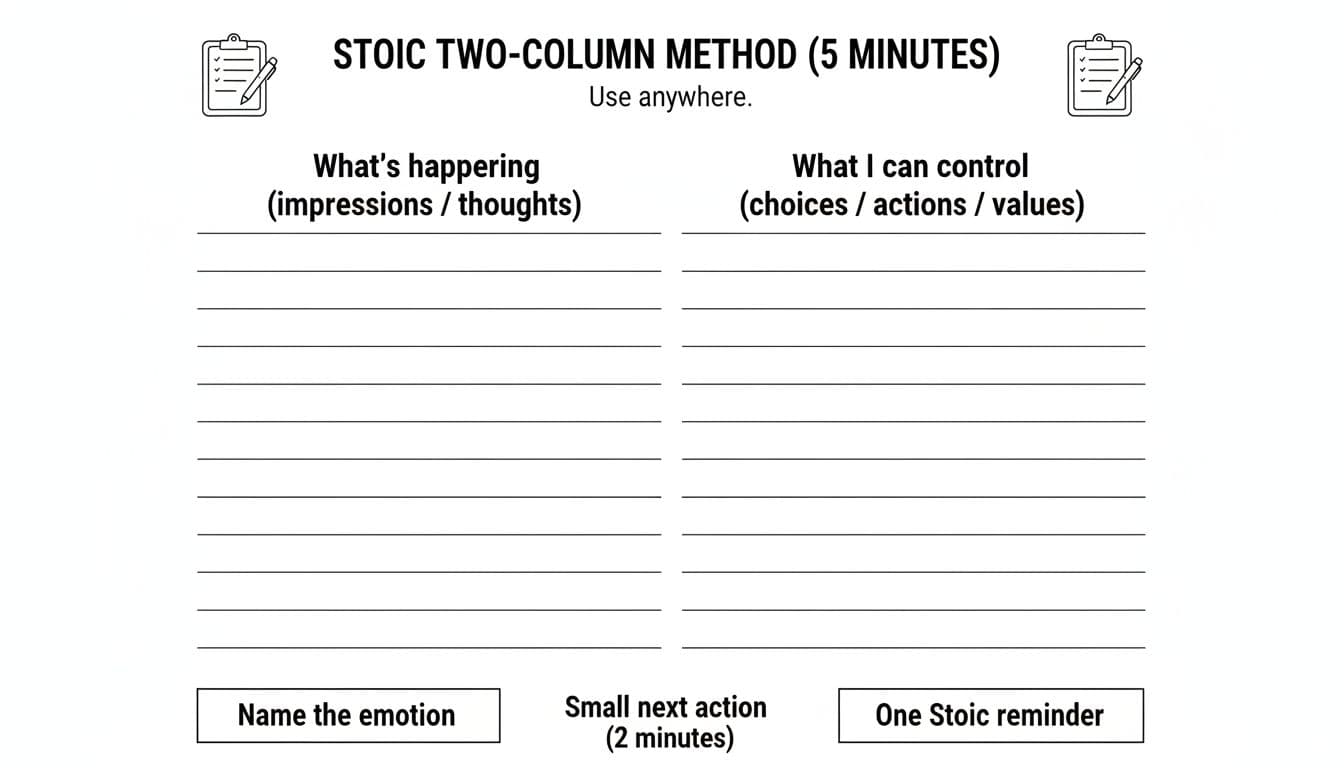
If you want this to be automatic, make it easy to repeat. I keep a few printed copies in my bag, or digital tablet and one photo of the blank template on my phone.
The 5-minute worksheet
| What’s happening (impressions / thoughts) | What I can control (choices / actions / values) |
|---|---|
| ________________________________ | ________________________________ |
| ________________________________ | ________________________________ |
| ________________________________ | ________________________________ |
| ________________________________ | ________________________________ |
| ________________________________ | ________________________________ |
| ________________________________ | ________________________________ |
| ________________________________ | ________________________________ |
| ________________________________ | ________________________________ |
| Name the emotion | Small next action (2 minutes) | One Stoic reminder |
|---|---|---|
| __________ | __________ | __________ |
A quick example
Left: My client’s tone changed. I’m sure we’re losing the deal.
Right: Fact-check. Re-read their email once. Draft 3 calm questions. Exhale slowly 4 times. Ask my colleague to review my response.
Emotion: Fear.
Two-minute action: Write subject line + first sentence only.
Stoic reminder: I can’t control their reaction, I can control my clarity.
Ultra-short pocket version
I use this when I’m in an elevator or sitting in my car:
- Fact: ______
- Story I’m telling: ______
- My control (1 choice): breath, posture, next message, boundary, ask for help
- Next 2 minutes: ______
- Value: ______
Three variations
Beginner: Only write one line per column. Don’t chase the perfect thought. Pick one body lever (breath or posture) and one tiny action.
Advanced: Add one more line: What assumption am I treating as fact? Then rewrite it as a question you can test. These coping skills build deeper awareness over time.
Workplace and Leadership: Use the right column to practice clean leadership. One choice might be: Schedule a 10-minute check-in. Another might be: State the goal, then ask for input. Anxiety wants you to either control people or avoid them. A Stoic response is steady, direct, and fair. This acts as mental health tools for nervous system regulation, sharpening coping skills amid high-stakes decisions.
For building philosophical resilience, pair it with alternative Stoic exercises like the view from above or morning premeditatio.
Quick FAQ
Does this stop anxiety?
Not always. I don’t use it to erase feelings. I use it for anxiety management and stress relief to stop the spiral, so the feeling doesn’t hijack my next decision. Over time, the intensity often drops because I’m not feeding it, leading to greater peace of mind.
What if nothing feels controllable?
Then I go smaller. I can control one exhale. I can relax my forehead. I can choose not to send the heated message. I can ask for support. Control isn’t fix everything, it’s choose the next inch. This approach supports anxiety management when spirals feel overwhelming.
Anxiety spirals shrink when I stop arguing with my mind and start organizing it. That’s the quiet power of this stoic journaling worksheet: it turns panic into paper, and paper into a next step, fostering peace of mind. If you try it once today, what’s the smallest controllable choice you can make in the next two minutes to stay in the present moment?